
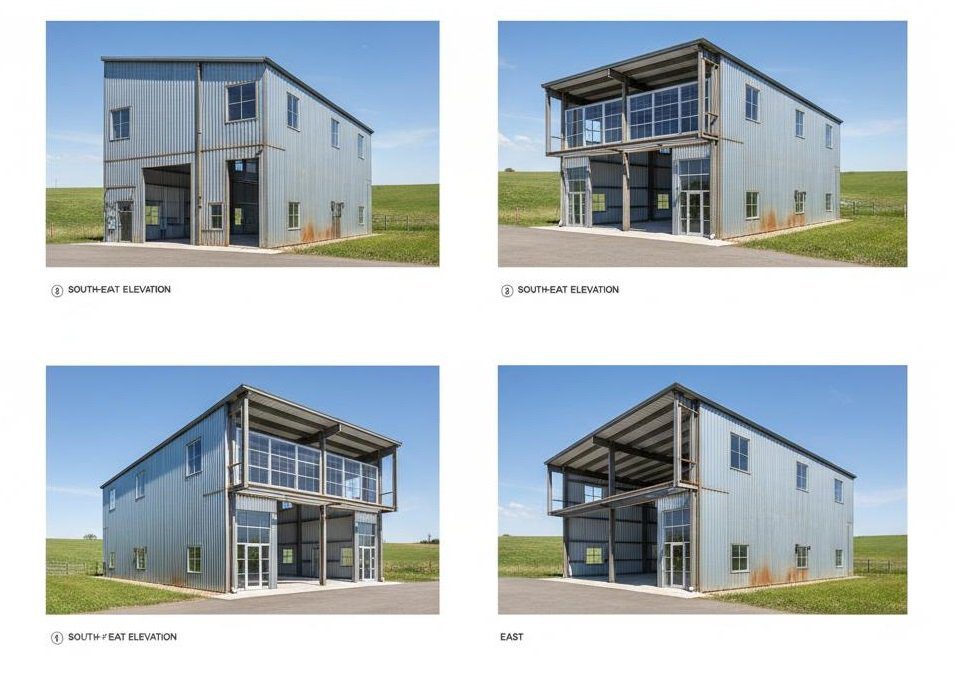
Design Challenges:
The project presented several significant technical challenges:
Heavy Loads: The structure needed to support a massive live load of 600psf.
Seismic Mass: Due to storage conditions, 25% of the live load had to be included as seismic mass, necessitating an advanced dynamic analysis.
Structural Optimization: The design had to account for P-delta effects and a redundancy factor (ρ), a linear dynamic analysis provided to safely optimize and reduce column and beam sizes.
Site Constraints: The foundation size had to be minimized due to the close proximity of a neighboring building.
S3DA Solutions:
Our team conducted extensive and advanced structural analysis to optimize the design for cost and safety. By performing a linear dynamic analysis, we accurately modeled the seismic behavior and structural response. This allowed us to precisely engineer the steel frame and column sizes, ensuring they met all code requirements without being over-designed. For the foundation, we developed a system that provided the required bearing capacity with a minimal footprint, respecting the tight property line constraints.
Key Design Features
Advanced Structural Analysis: A linear dynamic analysis was performed to precisely calculate seismic demands and optimize the entire structural system for the high storage loads.
BIM Coordination: The use of BIM was critical for coordinating the complex steel structure, ensuring all elements fit perfectly and preventing costly on-site clashes.


